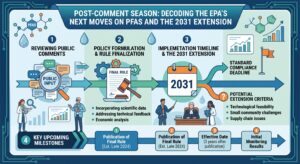
As the dust settles from the intensive public comment periods and agency hearings surrounding the EPA’s proposed rule changes, August marks a critical strategic juncture for industrial operators, municipal leaders, and facility managers. With the formal comment window closed on the EPA’s proposed PFOA and PFOS compliance deadline extensions—which aim to provide a potential runway out to 2031—and ongoing evaluations of broader contaminant frameworks, the strategy moving forward requires sharp, forward-looking execution.
The summer updates have created a uniquely layered regulatory environment. While federal adjustments and proposed rule revisions seek to smooth out implementation bottlenecks and address technical feedback from water systems, the overarching trajectory of environmental enforcement remains fixed: per- and polyfluoroalkyl substances (PFAS) are under permanent, unyielding scrutiny. For organizations managing complex waste streams, biosolids, or industrial sludge, understanding how to navigate this interim landscape will determine who thrives over the next decade and who gets left behind by shifting liabilities.
Navigating the Shift: Federal Timelines vs. Local Realities
For many utility and facility directors, the initial news of a potential compliance timeline extension to 2031 felt like a welcome exhale. Meeting stringent Maximum Contaminant Levels (MCLs) under compressed schedules requires massive capital outlays, engineering overhauls, and operational realignment. However, treating this federal window as a vacation from capital planning is a high-stakes operational gamble.
- State Standards Aren’t Waiting for Federal Adjustments
Even as federal frameworks experience transitional tweaks and proposed timeline expansions, state-level environmental agencies continue to enforce strict, localized limits that often outpace federal guidelines. Relying purely on a federal “wait-and-see” approach leaves facilities acutely vulnerable to state-level penalties, citizen lawsuits, and regional enforcement actions. State regulators have made it clear that public health protection will not hit pause simply because federal administrative timelines are under review.
- The Case-by-Case Catch of the 2031 Extension
Crucially, the proposed 2031 extension is not a blanket, unconditional waiver for every water system or industrial discharger. It operates strictly on an application basis, requiring systems to prove they are actively taking all “practicable compliance steps”. Furthermore, facilities exhibiting higher baseline concentrations—such as those at or above threshold triggers like 12 parts per trillion (ppt)—face mandatory interim control measures, rigorous documentation requirements, and heightened transparency mandates during the exemption period. Facilities that adopt a passive posture will find themselves hard-pressed to secure exemptions or justify delays to oversight bodies.
The Death of “Disposal”: Why Containment is a Liability
Simultaneously, the release of the EPA’s updated Interim Guidance on the Destruction and Disposal of PFAS has sharpened the focus on what happens to concentrated waste once it is captured. For years, traditional disposal methods—such as land application of biosolids, deep-well injection, and baseline landfilling—served as standard operational practices. Today, those methods are viewed through a lens of escalating liability.
The Leachate and Migration Problem: New data integrated into federal guidance underscores that even advanced RCRA-permitted landfills can experience higher long-term environmental release rates of PFAS than previously modeled. Because synthetic “forever chemicals” do not break down naturally, capturing them in a landfill or filtering them out via granular activated carbon (GAC) only relocates the problem. It transforms an active fluid stream into a localized time bomb.
Liability Creep and Generator Responsibility: As federal and state frameworks increasingly classify PFAS under hazardous substance definitions, the legal liability for “disposed” waste follows the original generator indefinitely. If a landfill or land-applied agricultural field leaks decades down the line, the facility that originally generated the sludge remains on the hook for remediation costs.
The Regulatory Preference for Permanent Destruction: The EPA’s updated guidance explicitly prioritizes technologies that demonstrate absolute destruction capabilities with the lowest potential for environmental release. Regulatory bodies are moving toward a framework where facility operators must actively justify any choice of disposal over permanent destruction.
Locking In Permanent Destruction via Hydrothermal Liquefaction (HTL)
The real takeaway from the post-comment season is that interim containment and traditional disposal are rapidly closing windows. To achieve true regulatory immunity, operators must transition from “capture-and-store” models to permanent, on-site destruction infrastructure.
This is where advanced thermal-chemical technologies like Hydrothermal Liquefaction (HTL) suggested by Clean Stream Fuels redefine the standard:
- Breaking the Carbon-Fluorine Bond: Conventional incineration often struggles to achieve the exact residence times and high-temperature profiles required to break the resilient carbon-fluorine bond without risking incomplete combustion or harmful air emissions. HTL utilizes subcritical and supercritical water environments under high pressure, creating a dense water-phase matrix that forces the total cleavage and mineralization of PFAS molecules into simple, harmless mineral salts.
- Eliminating Long-Tail Liabilities: By destroying PFAS at the molecular level on-site, HTL completely removes the need for long-term landfill hauling or off-site storage. You eliminate the generator’s perpetual liability chain in a single operational step.
- Transforming Waste into Value: Unlike standard destruction methods that represent a pure cost center, HTL goes a step further. It converts the organic components of biosolids and municipal or industrial sludge into a high-value, energy-dense biocrude. What was once treated as a toxic regulatory burden becomes a revenue-generating renewable energy asset that feeds directly into compliance frameworks like the Renewable Fuel Standard (RFS) and Section 45Z tax credits.
- Advanced Water Recovery: Beyond biocrude generation, cutting-edge HTL systems treat process byproducts to recover clean, clear water. This high-quality water can be safely reintroduced back into industrial cooling systems or plant processes, effectively offsetting local potable water demand and closing the loop on facility water management.
Recalibrating Your Strategy for the Rest of 2026
August is the definitive month to recalibrate. The regulatory turbulence of the summer—spanning proposed UCMR 6 monitoring rules, compliance deadline reviews, and updated destruction guidance—proves that environmental standards will only tighten as robust data collection takes hold.
Do not let shifting federal timelines or proposed compliance extensions lull your organization into operational complacency. Use this interim breathing room to evaluate your facility’s baseline data, audit your industrial influents, and transition away from temporary fixes.
By investing in permanent, destruction-based infrastructure like that offered by Clean stream Fuels, your facility transcends the cycle of regulatory whiplash. You stop managing liabilities, start generating valuable resources, and ensure that your operations meet the challenges of 2031—and beyond—with total confidence.